


The letter below was sent to leaders of Congress, urging them to ensure our overseas military have a chance to vote in the November election. If you’d like to learn more, reach out.
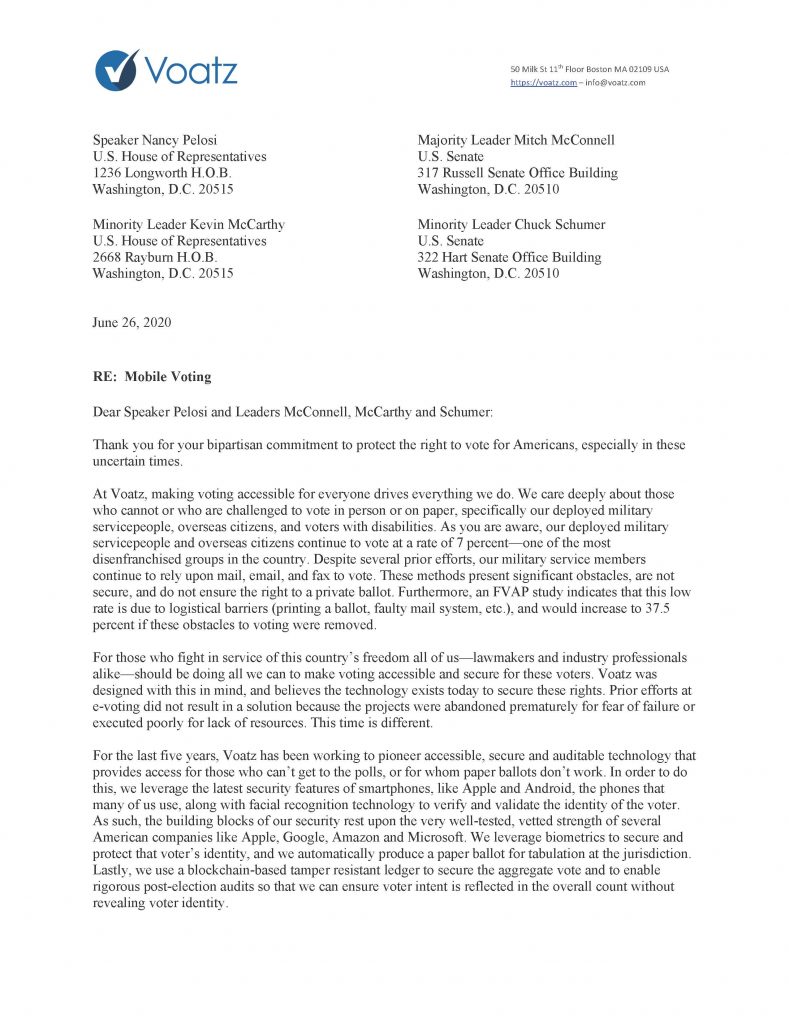
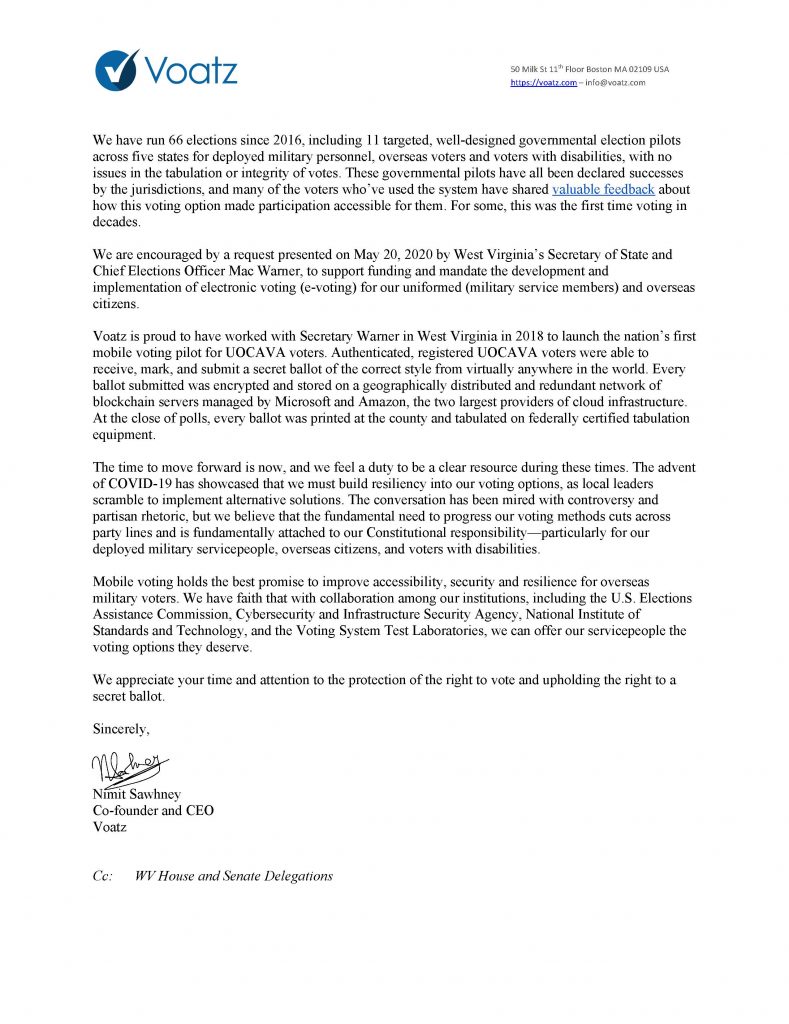
Text of the letter
Voatz
50 Milk St, 11th Floor, Boston MA 02109 USA
https://voatz.com – info@voatz.com
Speaker Nancy Pelosi
U.S. House of Representatives
1236 Longworth H.O.B.
Washington, D.C. 20515
Majority Leader Mitch McConnell
U.S. Senate
317 Russell Senate Office Building
Washington, D.C. 20510
Minority Leader Kevin McCarthy
U.S. House of Representatives
2668 Rayburn H.O.B.
Washington, D.C. 20515
Minority Leader Chuck Schumer
U.S. Senate
322 Hart Senate Office Building
Washington, D.C. 20510
June 26, 2020
RE: Mobile Voting
Dear Speaker Pelosi and Leaders McConnell, McCarthy and Schumer:
Thank you for your bipartisan commitment to protect the right to vote for Americans, especially in these uncertain times.
At Voatz, making voting accessible for everyone drives everything we do. We care deeply about those who cannot or who are challenged to vote in person or on paper, specifically our deployed military servicepeople, overseas citizens, and voters with disabilities. As you are aware, our deployed military servicepeople and overseas citizens continue to vote at a rate of 7 percent—one of the most disenfranchised groups in the country. Despite several prior efforts, our military service members continue to rely upon mail, email, and fax to vote. These methods present significant obstacles, are not secure, and do not ensure the right to a private ballot. Furthermore, an FVAP study indicates that this low rate is due to logistical barriers (printing a ballot, faulty mail system, etc.), and would increase to 37.5 percent if these obstacles to voting were removed.
For those who fight in service of this country’s freedom all of us—lawmakers and industry professionals alike—should be doing all we can to make voting accessible and secure for these voters. Voatz was designed with this in mind, and believes the technology exists today to secure these rights. Prior efforts at e-voting did not result in a solution because the projects were abandoned prematurely for fear of failure or executed poorly for lack of resources. This time is different.
For the last five years, Voatz has been working to pioneer accessible, secure and auditable technology that provides access for those who can’t get to the polls, or for whom paper ballots don’t work. In order to do this, we leverage the latest security features of smartphones, like Apple and Android, the phones that many of us use, along with facial recognition technology to verify and validate the identity of the voter. As such, the building blocks of our security rest upon the very well-tested, vetted strength of several American companies like Apple, Google, Amazon and Microsoft. We leverage biometrics to secure and protect that voter’s identity, and we automatically produce a paper ballot for tabulation at the jurisdiction. Lastly, we use a blockchain-based tamper resistant ledger to secure the aggregate vote and to enable rigorous post-election audits so that we can ensure voter intent is reflected in the overall count without revealing voter identity.
We have run 66 elections since 2016, including 11 targeted, well-designed governmental election pilots across five states for deployed military personnel, overseas voters and voters with disabilities, with no issues in the tabulation or integrity of votes. These governmental pilots have all been declared successes by the jurisdictions, and many of the voters who’ve used the system have shared valuable feedback about how this voting option made participation accessible for them. For some, this was the first time voting in decades.
We are encouraged by a request presented on May 20, 2020 by West Virginia’s Secretary of State and Chief Elections Officer Mac Warner, to support funding and mandate the development and implementation of electronic voting (e-voting) for our uniformed (military service members) and overseas citizens.
Voatz is proud to have worked with Secretary Warner in West Virginia in 2018 to launch the nation’s first mobile voting pilot for UOCAVA voters. Authenticated, registered UOCAVA voters were able to receive, mark, and submit a secret ballot of the correct style from virtually anywhere in the world. Every ballot submitted was encrypted and stored on a geographically distributed and redundant network of blockchain servers managed by Microsoft and Amazon, the two largest providers of cloud infrastructure. At the close of polls, every ballot was printed at the county and tabulated on federally certified tabulation equipment.
The time to move forward is now, and we feel a duty to be a clear resource during these times. The advent of COVID-19 has showcased that we must build resiliency into our voting options, as local leaders scramble to implement alternative solutions. The conversation has been mired with controversy and partisan rhetoric, but we believe that the fundamental need to progress our voting methods cuts across party lines and is fundamentally attached to our Constitutional responsibility—particularly for our deployed military servicepeople, overseas citizens, and voters with disabilities.
Mobile voting holds the best promise to improve accessibility, security and resilience for overseas military voters. We have faith that with collaboration among our institutions, including the U.S. Elections Assistance Commission, Cybersecurity and Infrastructure Security Agency, National Institute of Standards and Technology, and the Voting System Test Laboratories, we can offer our servicepeople the voting options they deserve.
We appreciate your time and attention to the protection of the right to vote and upholding the right to a secret ballot.
Sincerely,
Nimit Sawhney
Co-founder and CEO
Voatz
Cc: WV House and Senate Delegations